Yayoi Kusama Dies at 97: How the Infinity Mirror Rooms Rebuilt the Museum Around the Photograph
The studio waited two weeks to say anything. Kusama died on August 14 in a Tokyo hospital, and the announcement came on the 27th, by which point the obituaries had to be written at speed and all of them reached for the same nouns. Dots. Pumpkins. Mirrors. The red wig.
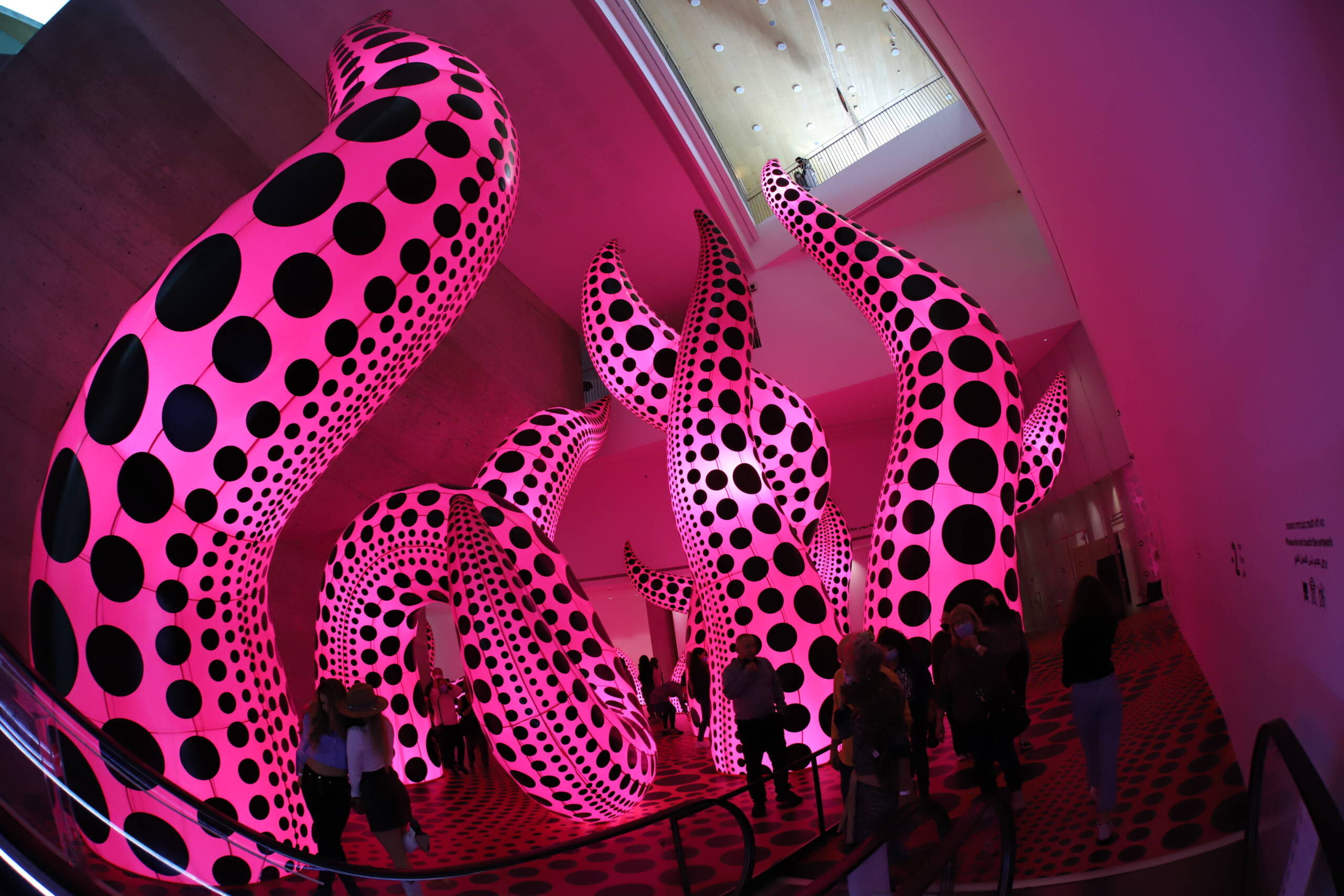
Those are fine as far as they go. But the part of her career that changed other people’s institutions, rather than just her own prices, happened in a three-month window in Washington in 2017, and museums have been living inside the consequences ever since.
The Hirshhorn Numbers
“Yayoi Kusama: Infinity Mirrors” opened at the Hirshhorn in February 2017, the first exhibition to gather six of the mirror rooms in one place. It closed in mid-May. In that span the museum put nearly 160,000 people through the show and 475,000 through the building and sculpture garden, its best spring since it opened in 1974 and roughly double what it normally did in those months. Annual attendance hit 1.2 million. Membership rose by something over 6,500 percent, which is the kind of figure that gets read out loud in board meetings.
Then it toured. Seattle, Los Angeles, Toronto, Cleveland, Atlanta. Another 800,000-plus over two years, with several of those museums recording seasonal attendance among the highest in their history.
The demand curve was the real story. When the Hirshhorn released free timed passes online, more than 58,000 people tried to claim them inside the first minute. The museum had to run bot countermeasures and work with resale platforms to stop people flipping free tickets. Lines for same-day walk-up passes formed before 9:30 in the morning. A federally funded museum on the National Mall was running scalper defense for an art exhibition.
And the hashtag reached 93 million accounts and generated 355 million impressions during the run. That number is the hinge. It is not a measure of how many people saw the art. It is a measure of how many people saw other people photographing the art.
Twenty Seconds
Here is the design constraint that made the whole thing work, and it is the part most of the tributes skip.
Visitors got twenty seconds inside each room. Twenty seconds, then an attendant moved you along. That limit was not an unfortunate crowd-control compromise imposed on a contemplative artwork. It was the artwork’s operating condition, and it produced exactly the behavior the room needed. Twenty seconds is not enough time to look. It is precisely enough time to take a picture.
So everyone took a picture. And because the room is mirrored, the picture always contains the photographer. That is the mechanism. A Rothko does not put you in the frame. Phalli’s Field, the first of the rooms, dates to 1965 and was already doing this decades before anyone had a phone to point at it. Kusama built a machine that produces a portrait of the visitor standing inside an artwork, and then the internet arrived and gave that output a distribution network.
Museums noticed. Everything that followed, the ticketed immersive experience, the van Gogh projection warehouse, the room built to photograph well, the wall text about “stepping into” the work, descends from what the Hirshhorn’s numbers proved. You could argue the ancestry runs back to Kusama’s own Happenings in New York in the sixties, where she painted dots on naked bodies in Central Park and understood perfectly well that the press coverage was part of the piece. She was never naive about attention. She wanted it, said so, and spent years in relative obscurity not getting it.
What the Rooms Were Actually For
The uncomfortable bit is that the rooms are about self-obliteration. That was her word. The dots proliferate until the boundary between the person and the field dissolves, which is a description of the hallucinations she had experienced since childhood and painted her way through for seventy years. She lived voluntarily in a Tokyo psychiatric hospital from the late seventies onward and walked to her studio each morning to work.
The rooms stage disappearance. Millions of people queued for hours to enter them, stayed twenty seconds, and used them to produce a photograph in which they are unmistakably visible, centered, and multiplied to infinity.
Kusama never seemed bothered by this, which is either the most generous thing about her or the most knowing. She said openly that she was fighting for her art to survive her, that she wanted people to stay interested after she was gone. The mirror rooms were an extraordinarily effective way to arrange that. They enlisted the audience as the distribution channel.
Her studio says she painted until the end. Somewhere in a museum today, a line is forming.