Pieter Aertsen and the Dignity of the Market Floor
The Kunsthistorisches Museum in Vienna holds one of the strongest concentrations of Flemish and Netherlandish painting outside the Low Countries themselves, and the Aertsen panels in its collection are among the least-celebrated works in a building that also contains Bruegel’s Tower of Babel and Vermeer’s Art of Painting. That context matters. Hung among dynastic portraits and Italian altarpieces, the market scenes register their strangeness more clearly than they would in a museum organized around genre painting as a category. Pieter Aertsen painted the market not as backdrop but as subject. In this mid-sixteenth century panel — a poultry seller occupying the full foreground plane, a wicker cage bursting with live birds beneath his hands, a dead fowl raised casually overhead — the commercial transaction is the painting’s entire argument. There is no apology for it, no religious scene pushed to the periphery to justify the secular subject matter. The merchant looks directly outward. He is not performing for a patron. He is working.
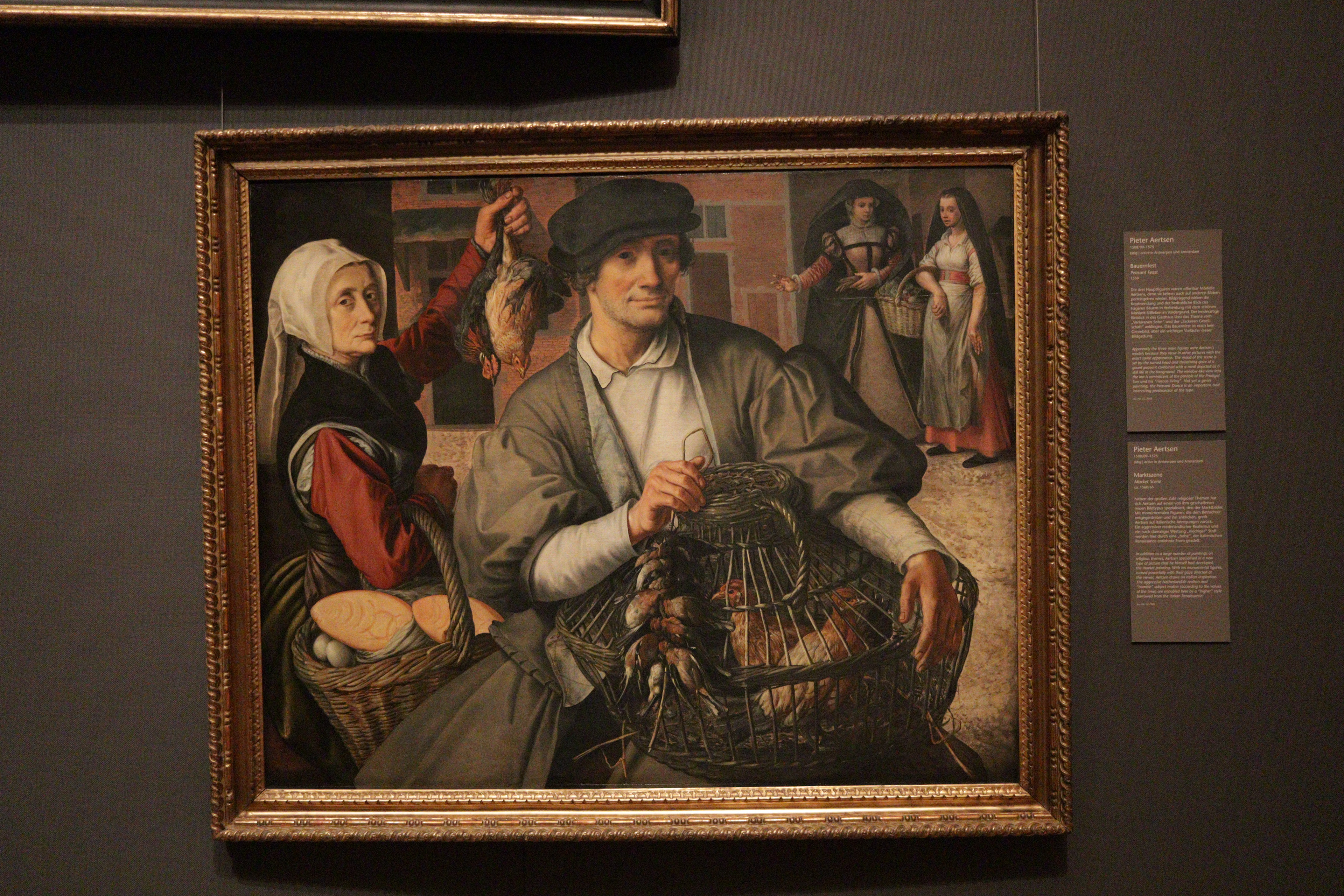
Aertsen, born in Amsterdam around 1508 and active primarily in Antwerp before returning north, helped invent the genre painting as a serious category of Flemish art. His contemporaries in the Italian tradition were still organizing their canvases around sacred narratives or aristocratic portraiture. Aertsen organized his around the weight of a chicken, the weave of a basket, the particular posture of someone who has stood in the same market stall for thirty years. The result was something the sixteenth century did not quite have language for: painting that treated working people as worthy of the same formal attention previously reserved for saints and sovereigns.
The composition here follows his characteristic logic. The male poultry seller dominates the center, physically large and rendered with a directness that reads as psychological rather than merely formal. To his left, an older woman sits among bread loaves and eggs — a separate vendor, or a companion, the relationship deliberately ambiguous. Behind them, two younger women carry baskets into a courtyard, the background receding into the warm brick architecture typical of Flemish urban space. The figures in the back are smaller, softer in handling, occupying a different register of social visibility than the foreground merchants. That recession is not accidental. Aertsen understood how depth functions as hierarchy, and then subverted it by placing the most commanding figure at the bottom of the pictorial ladder.
The cage of live birds in the foreground is rendered with a specificity that would have been recognizable to any Antwerp market-goer of the 1550s and remains tactile five centuries later. This is one of Aertsen’s persistent strategies: objects so particular that they anchor the painting in a specific material world, preventing the scene from resolving into allegory. Scholars have argued for years about the moralizing subtext in his work — whether the market scenes encode commentary on vanity, gluttony, or the transience of earthly goods. The argument is not wrong, but it risks undervaluing what is most radical about these paintings. Aertsen gave the ordinary world his full attention. Whatever the coded message, the chickens are real.