The Library as Argument: Inside the Rijksmuseum Research Library
The Rijksmuseum Research Library was not designed to be convenient. It was designed to be overwhelming. Four floors of floor-to-ceiling shelving rising on all sides of a central atrium, tens of thousands of volumes visible at once, the ironwork galleries and spiral staircases carrying the eye upward and outward until the scale of accumulated knowledge becomes the first and most insistent thing the room communicates. Two researchers sit at a lit table on the ground floor, reduced to near-insignificance by the architecture around them. This is not accidental. It is the point.
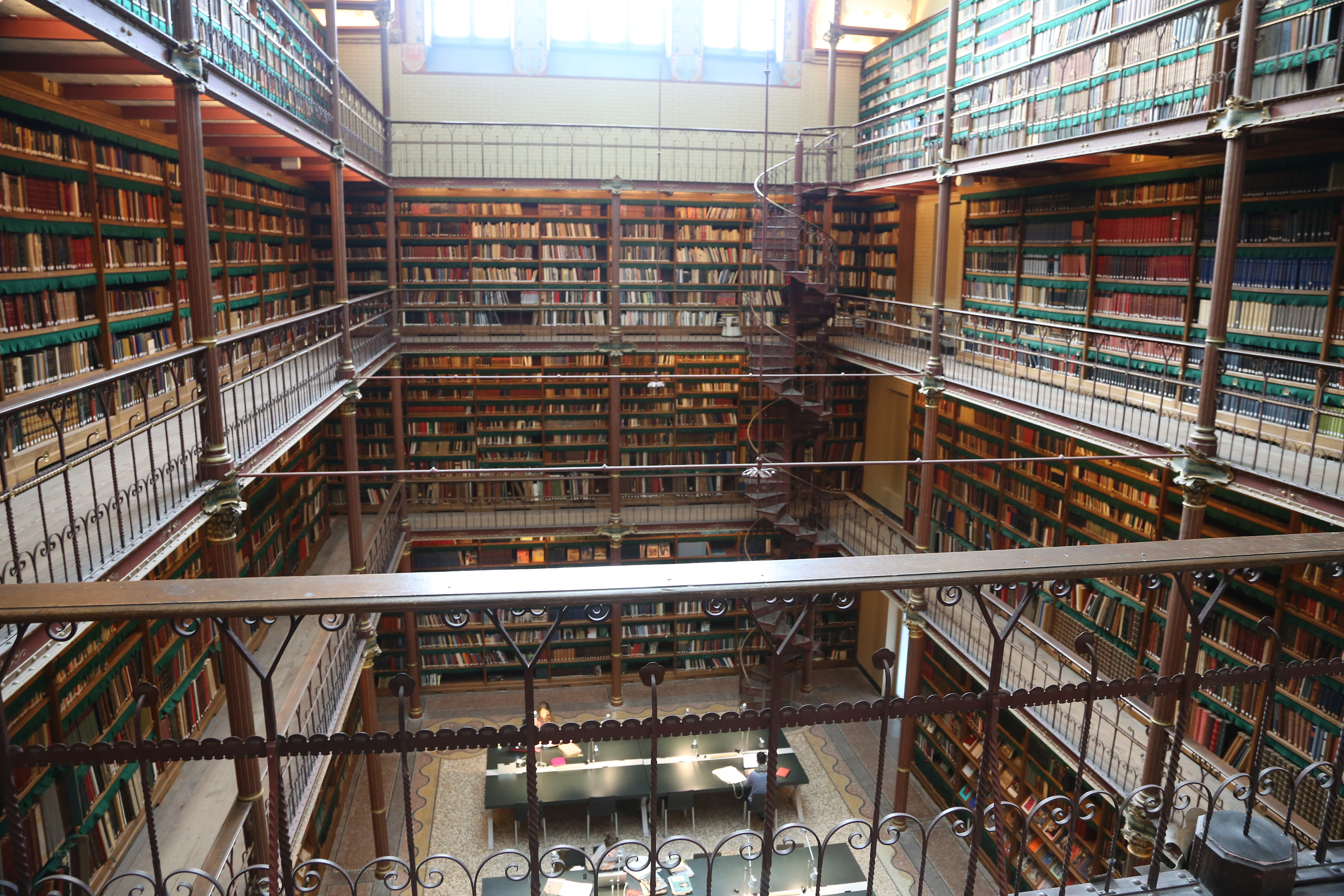
The institutional library of the nineteenth century was a rhetorical object. Its architecture made arguments about knowledge, nation, culture, and the institution that housed the collection. The argument varied in emphasis — some libraries performed democratic accessibility, others performed exclusivity — but the basic grammar was consistent: height signaled depth, density signaled comprehensiveness, permanence of material signaled permanence of the institution’s purpose. The reader who entered was positioned, spatially and psychologically, as a figure in relation to something much larger than themselves.
The Rijksmuseum Research Library occupies a room within the museum’s main building, completed in 1885 to the design of Pierre Cuypers — the same architect responsible for Amsterdam’s Centraal Station, built in the same decade. Cuypers worked in a historicist mode that drew on Gothic and Dutch Renaissance sources, and the library’s interior carries the same monumental seriousness as the building around it. The green-trimmed shelving, the dark ironwork, the natural light falling from above — these are not decorative decisions. They create a specific quality of attention, a sensory environment calibrated to serious work.
What the photograph captures, from an upper gallery looking down, is the spatial argument in its purest form. The two figures at the table are not incidental to the composition. They are what the room was built for, and their smallness in relation to the shelves is an accurate measure of what the library proposes: that the individual researcher is a temporary visitor to an accumulated conversation that began long before them and will continue long after.
This is also, quietly, an argument about time. The physical library imposes a relationship to the past that digital access does not replicate. A digitized collection is flat — every document equally accessible, equally present, equally weightless. The physical library is stratified. The older volumes on the upper shelves require the spiral staircase. Some collections are closed. Some materials must be requested and handled under supervision. These frictions are not failures of efficiency. They encode a proposition about the relationship between access and custodianship — that some materials require care that convenience cannot accommodate.
The Rijksmuseum Research Library holds one of the most significant art history collections in Europe: more than 350,000 volumes, sale catalogs dating to the seventeenth century, artists’ archives, auction records, and primary sources that underpin much of what is known about Dutch and Flemish art. Researchers sit at that lit table on the ground floor with access to documentation that does not exist anywhere else in the same form. The architecture around them is not incidental to that work. It is the institution’s statement of what the work is worth.