How to Look at Gauguin Now
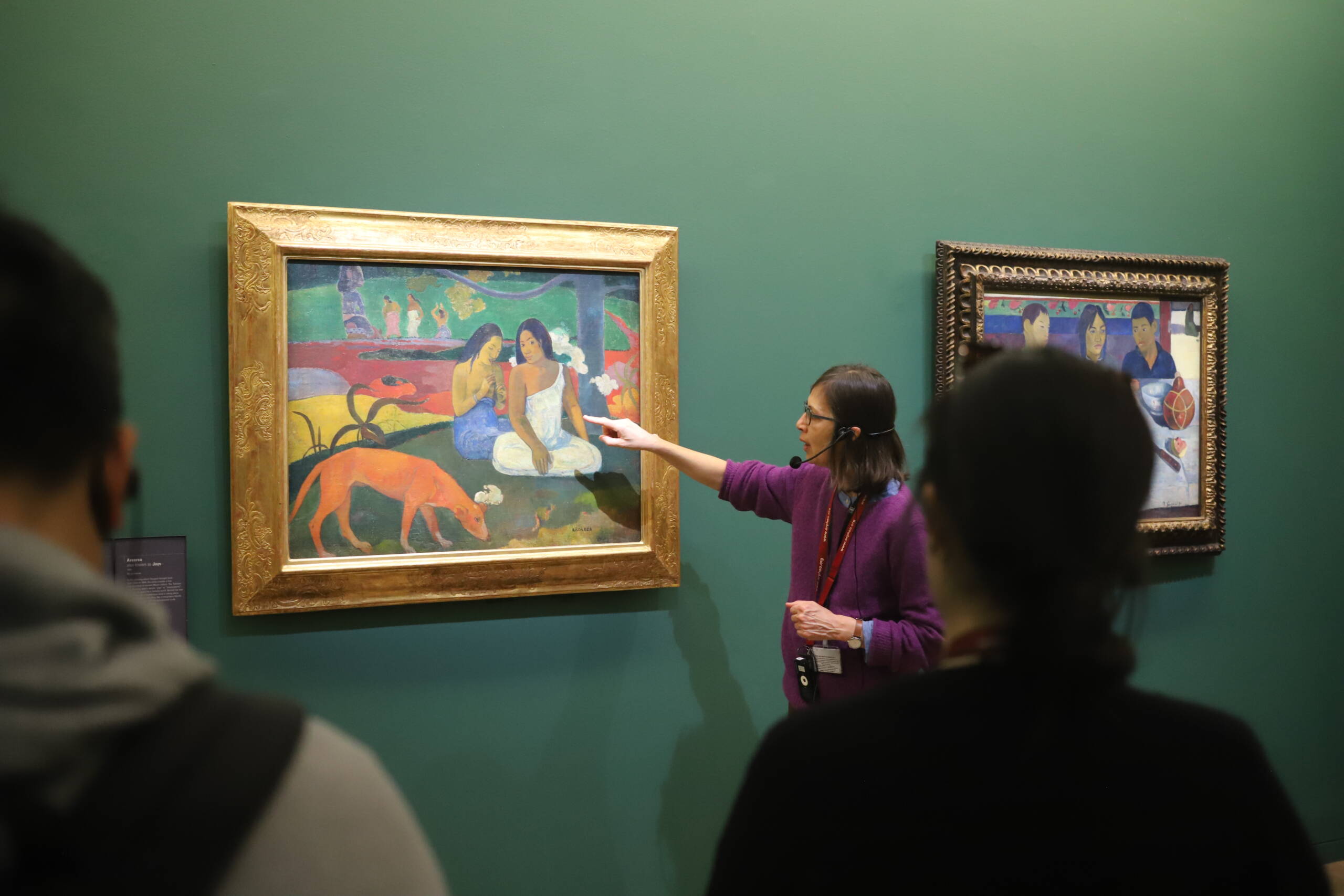
A museum guide stands in front of Arearea and points. The group behind her looks where she directs them. This is how most people encounter Gauguin — mediated, framed, explained. The painting on the wall at the Musée d’Orsay is one of the most reproduced images in the Western canon: two Tahitian women seated in a lush landscape, a red dog in the foreground, the color saturated to a pitch that has no equivalent in European painting before it. It is genuinely beautiful. It was made under conditions that are genuinely indefensible. The question of how to hold both of those facts at once is one the museum’s label cannot fully resolve, and neither can the guide’s pointing hand.
Paul Gauguin arrived in Tahiti in 1891 carrying a set of ideas about the Pacific that were wholly European in origin. He expected to find a prelapsarian world untouched by modernity — an expectation formed by reading travel literature and looking at the Pacific exhibits at the 1889 Exposition Universelle in Paris, where French colonialism had staged its territories as living dioramas for metropolitan consumption. What he found was a French colony with a colonial administration, a partially Christianized population, and a society already significantly transformed by a century of contact. He worked to ignore this and largely succeeded, painting a Tahiti that confirmed the fantasy he had brought with him rather than the place he was actually in.
The women in his paintings were frequently his vahines — the term itself a colonial convenience — girls and young women, some of them teenagers, in relationships that by any honest account involved significant coercion. The power differential was absolute: a European man, however financially precarious, in a colonial territory where the colonized population had no legal recourse against him. This is not a fact that exists separately from the paintings. It is a fact about the conditions of their production, and it bears on how the images work and what they are doing.
Arearea — the title means “amusement” or “joyfulness” in Tahitian — deploys a visual language of ease and pleasure that is inseparable from the fantasy it constructs. The red dog is borrowed from a Peruvian ceramic Gauguin had seen in Paris; the figures are posed rather than observed; the background collapses spatial logic in ways that signal deliberate primitivism, a flattening of perspective that Gauguin associated with non-European art and used to signal that he was operating outside Western conventions. The painting is a construction of Tahiti as European imagination required it to be, not as it was.
None of this makes the color less astonishing. The red of the dog against the green of the foliage is an optical event that retains its force regardless of the argument about what produced it. This is the difficulty that easy condemnation evades: the work is both aesthetically consequential and ethically compromised, and treating either fact as sufficient by itself produces a diminished account of both. The critic who dismisses the painting on ethical grounds alone cannot explain why it continues to command attention. The critic who insists on pure aesthetic reception cannot explain what the painting is actually of.
What the guided tour in the photograph offers — what the pointing hand is doing — is a mediated entry into this complexity, though the mediation rarely names it directly. Museum interpretation has become more willing in recent years to address the colonial context of collection and display, but the address is often brief, positioned at the end of an account that has already done most of its work aesthetically, and calibrated not to disturb the pleasure of the visit too severely. The painting stays on the wall. The label frames it. The guide explains it. The group looks where the finger points.
Looking seriously at Gauguin means looking at all of it — the color, the construction, the fantasy, the exploitation, and the fact that a century of viewers have found the result beautiful enough to keep looking. That discomfort is not a reason to stop. It is a reason to be more precise about what you are seeing when you do.