Open Social Web Launches as a Guide for Independent Publishers on the Fediverse, Bluesky, RSS and AI Crawlers
Every independent publisher eventually asks the same question: who actually holds the relationship with my readers? For most of the last fifteen years the honest answer was a platform. A feed decided who saw the work, a search engine decided who found it, and the writer rented both. A new sister publication, Open Social Web, is built around that question and the tools that change the answer.
It covers the part of the internet a writer or small publisher can own, meaning the site, the feed, the domain and the followers tied to it, and the forces pulling the other way. Every post is written for someone who runs their own site. It launched with 20 pieces, each with a diagram of its own.
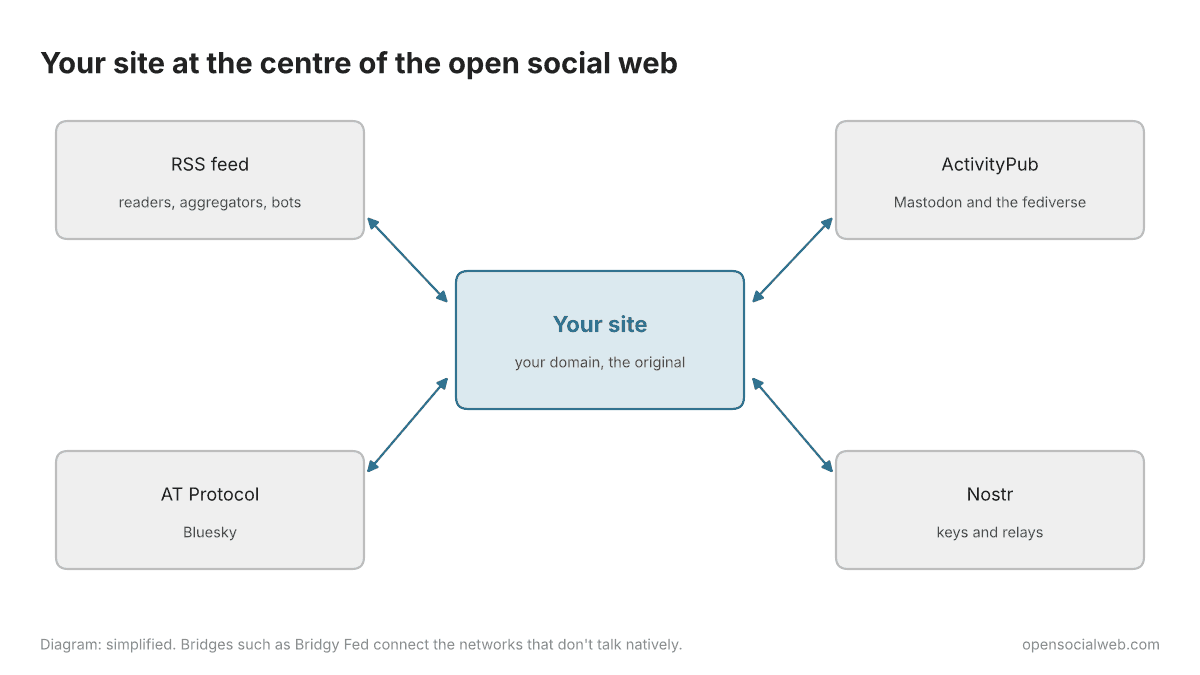
Diagram: Open Social Web, hosted at Pxef.com
Why it matters to people who publish seriously
This site has argued for a while that distribution is an editorial matter. The Pink News and Snapchat story showed what happens when one platform carries too much of a publication’s reach, and Building an Owned Audience laid out the alternative. Open Social Web picks up where those leave off, with the newer pieces: the fediverse, Bluesky, and the AI systems now reading everyone’s archives.
Two of its launch posts sit right next to this site’s beat. Newsletter vs RSS vs Fediverse asks which audience list a publisher truly owns, and the answer is less obvious than “the newsletter.” RSS for Publishers makes the case for the oldest open channel, a case we also made in RSS Is Still Relevant.
The tools, explained plainly
For writers who have heard the word “fediverse” and moved on, the guides start at the beginning. ActivityPub Explained for Website Owners shows how a blog can have followers on Mastodon without a separate account. The WordPress ActivityPub plugin guide walks through the setup, and replies come back as ordinary comments. For static sites, of the kind discussed in our WordPress vs Hugo piece, Bridgy Fed turns a site’s feed into an account on both the fediverse and Bluesky.
There’s a small, satisfying fix for bylines too. The fediverse:creator meta tag puts the author’s own account under every Mastodon link preview of their article, whoever shares it. And custom domain handles let a writer’s social address be their own site.
The harder news
The less comfortable posts deal with AI. AI Answers and Google Search Referrals charts how much search traffic small publishers have lost as answers appear on the results page, and the losses are steepest for the smallest sites. AI Crawlers and robots.txt sorts the bots that train models from the ones that might still send readers, and what blocking each one costs. For a writer deciding whether their back catalogue should feed someone else’s model, it pairs well with our AI and publishing piece.
The platform history is there as well. Four Times a Platform Change Cut Publishers Off runs from Facebook’s 2018 feed change to Meta’s news block in Canada, a record worth reading before trusting any channel you don’t control.
New posts appear twice a week. For everything published across the network in one place, Syndicator collects the feeds, and its blog has a companion piece on what an RSS feed needs to become a fediverse and Bluesky account.